

 Log In

LAST UPDATED
Jun 24, 2026
READ TIME
12 min
LAST UPDATED
Jun 24, 2026
READ TIME
12 min
Hubbard Glacier vs. Glacier Bay — two names, two completely different kinds of jaw-dropping. One is a single, advancing colossus that makes the ocean tremble. The other is a 3.3-million-acre national park with more than a thousand glaciers and some of the richest wildlife waters on the planet. Choosing between them is genuinely hard. Luckily, with Princess Cruises, you don’t always have to. With one of our Alaska cruises, you can visit the best sites in Alaska without having to worry about logistics.
Read on to learn about Hubbard Glacier and Glacier Bay National Park, so you can determine your dream Alaska cruise itinerary with Princess.
Key takeaways
-
Hubbard Glacier is North America’s longest tidewater glacier — 76 miles of ice — and one of the very few that is still advancing.
-
Glacier Bay National Park is a UNESCO World Heritage Site covering 3.3 million acres of fjords, rainforest, soaring peaks and more than 1,000 glaciers.
-
Princess Cruises holds the limited permits required to enter Glacier Bay and offers Hubbard Glacier scenic cruising on multiple Alaska itineraries.
How cruise visitors experience Alaska’s most iconic glaciers
Here’s a fun fact about both Hubbard Glacier and Glacier Bay: you can’t drive to either one. There are no roads, no parking lots, no visitor centers with gift shops. The only practical way in is by sea, which makes a cruise ship not just convenient, but essentially the only ticket to these places.
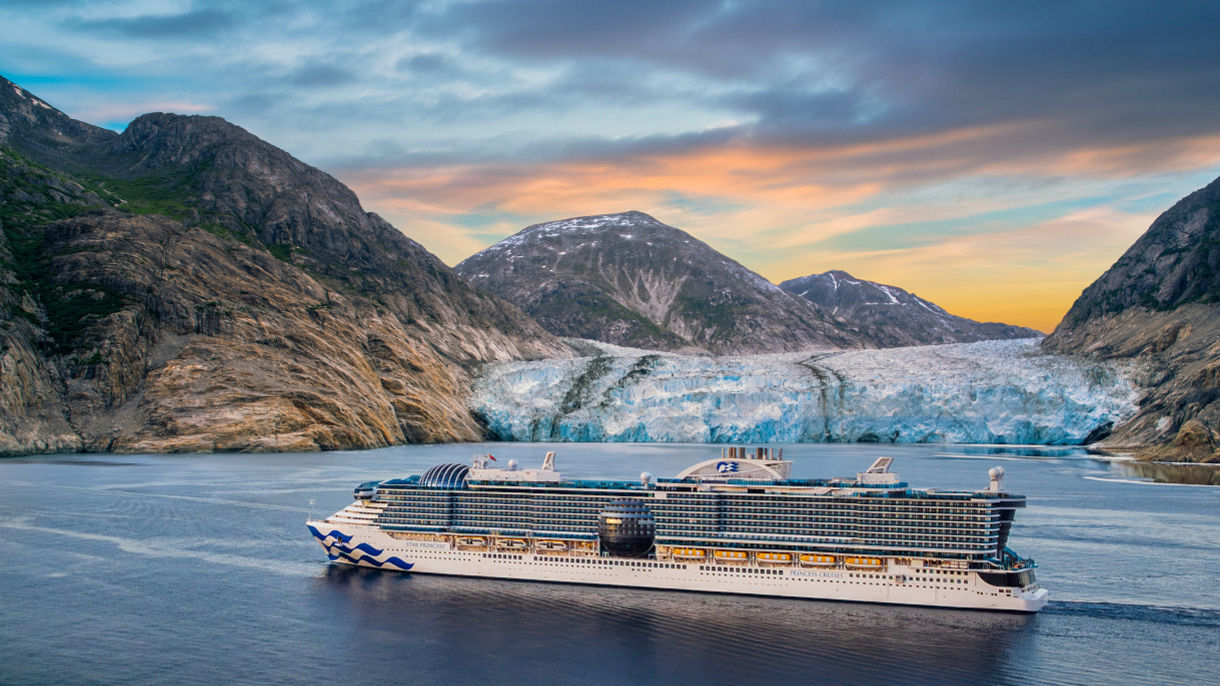
Princess ships carry the limited permits required to enter Glacier Bay National Park. Access isn’t guaranteed for just any vessel, which is part of what makes the experience feel so exclusive. Hubbard Glacier scenic cruising takes place in Disenchantment Bay, near the small community of Yakutat in southeast Alaska, where ships drift into position and let the glacier do the talking.
At both destinations, ships typically spend several hours drifting slowly at the glacier’s face, rotating so that every stateroom and every viewing deck gets a clear look. At Glacier Bay, National Park Service rangers, onboard naturalists and Huna Tlingit cultural interpreters provide narration throughout the day, turning a breathtaking view into a genuinely educational experience.


Start your Alaska adventure
Hubbard Glacier vs. Glacier Bay at a glance
Geographic location and scale
Start with sheer size because with these two destinations, size is very much the point.
Hubbard Glacier flows 76 miles from its source in Canada’s Yukon Territory down to its terminus in Disenchantment Bay. Where it meets the ocean, the face of the glacier stretches roughly six miles wide and rises about 400 feet above the waterline, with another 400 feet of ice lurking below the surface. Standing on a ship deck in front of it, you will feel genuinely small, in the best possible way.
Glacier Bay National Park operates at an entirely different scale. The park covers 3.3 million acres — roughly the size of Connecticut and Rhode Island combined — and contains more than 1,000 glaciers tucked into fjords, draped over mountain ridges and spilling down valley walls. The two main tidewater glaciers visited on Princess sailings are Margerie Glacier, known for its electric-blue ice and frequent calving, and the massive Grand Pacific Glacier at the head of Tarr Inlet.
Think of it this way: Hubbard delivers an unforgettable close-up to the wonders of Alaska’s glaciers. Glacier Bay gives you a whole overview of an unbelievable landscape.

Glacial behavior and movement
Most of Alaska’s glaciers are retreating — receding uphill, shrinking back into the mountains as temperatures warm. Hubbard Glacier is doing the opposite. It has been advancing steadily since it was first mapped in the 1890s, earning the nickname “the Galloping Glacier.” Scientists attribute this to Hubbard’s enormous accumulation zone in the St. Elias Mountains, which receives more than 100 feet of snowfall annually, constantly feeding the glacier forward at a rate of roughly 80 feet per year.
That advancing behavior has real consequences. In 1986 and again in 2002, Hubbard surged far enough to temporarily seal off the entrance to nearby Russell Fjord, briefly transforming it into “Russell Lake” before the ice dam eventually gave way. Scientists believe Hubbard could close that entrance permanently sometime in the coming decades, a geological event in slow motion.
Glacier Bay tells the opposite story. Just 250 years ago, the entire bay was buried under a single massive glacier, more than 100 miles long and thousands of feet deep. The Huna Tlingit oral histories describe the glacier advancing “at the speed a dog runs.” By the time naturalist John Muir visited in 1879, the ice had already retreated more than 30 miles, opening the bay. Today, most of the park’s glaciers continue to retreat, revealing freshly uncovered land that is only now beginning to support plant and animal life — a textbook example of glacial succession playing out in real time.
Pair both destinations on a Voyage of the Glaciers itinerary, and you’ll witness two very different chapters of glacial history in a single sailing.

Calving events and ice spectacle
Calving is the moment when a chunk of ice — sometimes the size of an apartment building — breaks free from the glacier face and crashes into the water below. The sound arrives a beat or two after the visual: a deep, resonant boom that seems to come from inside the earth, followed by a wave of churned white water. It is deeply, unreasonably satisfying to watch.
The Tlingit people have long called this sound “white thunder,” and Hubbard Glacier is famous for producing it constantly. Because the glacier is actively advancing, the ice at its face is under constant pressure — which means fractures are always forming, and calving happens frequently throughout the day. On a warm July afternoon, the glacier can be almost operatically loud.
At Margerie Glacier in Glacier Bay, the calving is equally dramatic and the vivid blue ice makes for stunning photographs. Floating icebergs, growlers and the smaller chunks called “bergy bits” drift through the surrounding waters at both locations, turning the sea into an obstacle course of ice sculptures. Princess captains maneuver the ship carefully to maximize viewing time at each glacier face.

Wildlife around the glaciers
The cold, nutrient-rich waters around both glaciers are extraordinarily productive, which means wildlife.
Glacier Bay is one of the great wildlife viewing destinations in North America. Around 100 individual humpback whales spend their summers feeding in the bay, along with orcas, sea otters, Steller sea lions and harbor seals. Along the shorelines, brown bears, mountain goats and moose are regularly spotted. More than 200 bird species pass through or nest in the park each year, including bald eagles and tufted puffins.
Hubbard Glacier has its own loyal fan base in the animal kingdom. Harbor seals especially love the glacier. They haul themselves up onto floating icebergs in Disenchantment Bay to rest, nurse their pups and generally look adorable. Tufted puffins and kittiwakes nest on rocky outcroppings near the glacier face in summer. Wildlife sightings at both destinations vary with season, tide and weather, so keep your binoculars handy and your expectations open.

Cultural and historical context
Glacier Bay is ancient land with a layered human story. The Huna Tlingit people have lived here for thousands of years, and their oral histories describe the glacier’s catastrophic advance during the Little Ice Age in vivid, precise detail. Geological evidence has since confirmed those accounts. The advancing ice eventually displaced the Huna Tlingit from their villages around 1750, forcing them south. They returned as the glaciers receded.
In 2016, the Huna Tribal House — known in Tlingit as Xunaa Shuká Hít, or “Huna Ancestor’s House” — opened at Bartlett Cove, offering visitors an introduction to Huna Tlingit culture, art and history that no other park in Alaska can match. Princess sailings through Glacier Bay include narration from Huna Tlingit cultural interpreters, giving the glaciers a human context that makes the whole experience richer.
Hubbard Glacier was named for Gardiner Greene Hubbard, the first president of the National Geographic Society. The Yakutat Tlingit have called the surrounding area home for generations, and the small community of Yakutat — accessible only by air or sea — sits at the edge of one of the most remote stretches of coastline in North America.

Ecological and environmental significance
Glacier Bay earned its UNESCO World Heritage designation for good reason. It is one of the world’s foremost outdoor laboratories for studying what happens after a glacier retreats: the progression from bare rock to moss to willow to alder to Sitka spruce, all happening within a single park, in stages you can actually see and compare. Scientists have been studying this ecological succession here for more than a century.
Hubbard Glacier offers the scientific community something rarer: a major tidewater glacier that is gaining mass and advancing in an era when almost every other glacier on earth is doing the opposite. That makes it a genuinely important reference point for glaciological research. Princess naturalists share the latest findings and conservation context during scenic cruising at both destinations.

How Hubbard Glacier and Glacier Bay compare to other Alaska glaciers
Hubbard Glacier vs. Dawes Glacier
If Hubbard Glacier is a wide-open amphitheater of ice, Dawes Glacier is a cathedral. Tucked at the end of Endicott Arm — a 30-mile fjord about 50 miles southeast of Juneau — Dawes rises about 600 feet tall and stretches roughly a mile across. It is dramatic, blue and loud.
What makes Dawes Glacier and Endicott Arm different is the approach. Endicott Arm is narrow and steep-sided, with granite walls streaked by hanging glaciers and waterfalls tumbling down from thousands of feet above. John Muir called it “a wild, untamed Yosemite.” As a ship moves deeper into the fjord, the water shifts from grey to jade, the temperature drops and the icebergs get larger. By the time Dawes comes into view around a bend, the buildup has been thoroughly earned.
Hubbard, by contrast, greets you head-on in the open waters of Disenchantment Bay — no buildup, just a six-mile wall of ice materializing on the horizon. Dawes vs. Hubbard ultimately comes down to setting: intimate fjord cathedral vs. wide-open ice amphitheater. Both are spectacular. They just tell their stories differently.

Dawes Glacier vs. Glacier Bay
Comparing Dawes Glacier to Glacier Bay is a bit like comparing a great short story to a novel. Endicott Arm delivers concentrated, vertical drama in a single extraordinary fjord. Glacier Bay gives you chapters.
The park is vast enough to contain dozens of destinations within itself — multiple tidewater glacier faces, sweeping wildlife habitat, beaches, fjords and the cultural richness of Bartlett Cove. Dawes Glacier is a single, brilliant scene. Glacier Bay is an entire landscape. Depending on the itinerary, some Princess sailings allow guests to experience both on the same voyage through the Inside Passage.

Planning your Alaska glacier cruise
Alaska cruise season runs from early May through late September, with peak glacier viewing in June, July and August — when the long daylight hours (we’re talking 18 or more hours of light in midsummer) mean you can watch for wildlife at practically any hour.
Seven-day itineraries from Seattle or Vancouver often include either Dawes Glacier or Glacier Bay scenic cruising. For the full glacier double-header, look for Voyage of the Glaciers itineraries sailing between Vancouver and Whittier — these pair Glacier Bay with either Hubbard Glacier or College Fjord for a one-two punch of ice scenery.

Packing tips
Dress in layers, even in midsummer. It can be 70 degrees and sunny in Juneau and 45 degrees with a sharp wind at the glacier face two hours later. Waterproof outerwear is not optional. Bring binoculars and a camera with a good zoom. The glacier face looks enormous from the ship, but the wildlife spotting rewards magnification. Onboard naturalist programming, National Park Service ranger talks and Huna Tlingit cultural interpretation are all included on Princess sailings through Glacier Bay, so you’re never just staring at ice — you’re learning what you’re looking at.
Book your Princess Alaska cruise
Glacier country rewards those who show up ready for it — with the right ship, the right position and the right people on deck to help you understand what you’re seeing. Princess Alaska cruises are built around exactly that.
With prime viewing decks designed to keep every passenger close to the action, expert naturalist narration, Huna Tlingit cultural interpretation and itineraries engineered around the best glacier viewing windows, Princess puts you in the best possible seat for Alaska’s greatest show. Whether you choose Hubbard, Glacier Bay or the Voyage of the Glaciers that gives you both, the ice is waiting.

Hubbard Glacier vs. Glacier Bay - FAQs


