

 Log In

LAST UPDATED
Jun 19, 2026
READ TIME
12 min
LAST UPDATED
Jun 19, 2026
READ TIME
12 min
Natural landmarks are geographic features shaped by Earth’s geological forces over thousands or even millions of years. Glaciers, fjords, coral reefs, volcanic coastlines and mountain ranges all tell part of the story of how the planet continues to evolve. Many of the world’s remarkable natural landmarks can also be experienced by sea, with Princess itineraries offering close access to places like Alaska’s tidewater glaciers, Norway’s fjords and New Zealand’s Fiordland coastline.
Key Takeaways
-
Natural landmarks are geographic features shaped by geological forces like glaciation, volcanism, tectonic activity and erosion over thousands or millions of years.
-
Some of the world’s most remarkable natural landmarks can be experienced by cruise, including Alaska’s tidewater glaciers, Norway’s fjords, Iceland’s lava fields, the Great Barrier Reef and New Zealand’s Fiordland coastline.
-
Protected designations such as UNESCO World Heritage Sites and National Parks help preserve many of these landscapes while supporting responsible tourism and long-term conservation efforts.
Understanding natural landmarks and how they form
Natural landmarks are distinct geographic features recognized for their scenic, ecological, geological or cultural significance. Some are immense in scale, like glaciers and mountain ranges, while others take shape as waterfalls, caves, coral reefs, volcanic coastlines or narrow fjords carved into the land over time.
These landscapes form through slow but powerful natural processes. Glaciers carve valleys through rock, tectonic plates push mountains upward and volcanic eruptions create entirely new terrain. Wind, rivers and ocean currents continue reshaping many of these environments long after their initial formation, sometimes across millions of years.
Many natural landmarks also hold deep cultural importance for Indigenous communities whose traditions and spiritual beliefs remain closely tied to the land. Today, formal protections such as UNESCO World Heritage designation and National Parks help preserve these fragile environments for future generations, including glacier regions featured on Alaska glacier cruises.
Natural landmarks you can experience on a Princess cruise
Some of the world’s most extraordinary natural landmarks are not just visible from the sea, but best experienced from it. Princess itineraries sail directly alongside many of these natural landmarks or sail you right to the port where you can see them on land. And, when you cruise, you can encounter several landmark regions within a single voyage.
1. Alaska's tidewater glaciers and fjords
Massive and constantly shifting, Hubbard Glacier is an extraordinary natural landmark in Alaska. Stretching roughly 76 miles through the Saint Elias Mountains, the glacier’s towering ice face spans nearly 6 miles across and rises hundreds of feet above the water at the head of Disenchantment Bay.
What makes the experience especially memorable is the glacier’s movement. During scenic cruising, guests may witness dramatic calving events as enormous slabs of ice break free and crash into the bay below, sending ripples across the water and echoing through the surrounding wilderness.
For an even closer look at this immense landscape, Hubbard Glacier Scenic Cruising brings guests directly into the glacier’s icy surroundings while naturalists help interpret the geology and scale of one of North America’s longest tidewater glaciers.

2. Cruise the protected waters of Glacier Bay National Park
Covering more than 3.3 million acres, Glacier Bay National Park cruises bring guests through one of Alaska’s most extraordinary wilderness landscapes. Massive glaciers descend into deep fjords while humpback whales, sea otters, mountain goats and brown bears thrive throughout the protected ecosystem.
Recognized as both a UNESCO World Heritage Site and National Park, Glacier Bay continues to be shaped by active glaciation and retreating ice. During scenic cruising, National Park rangers often come aboard Princess ships to share insight into the region’s wildlife and Tlingit cultural heritage.
3. Sail through Endicott Arm to Dawes Glacier
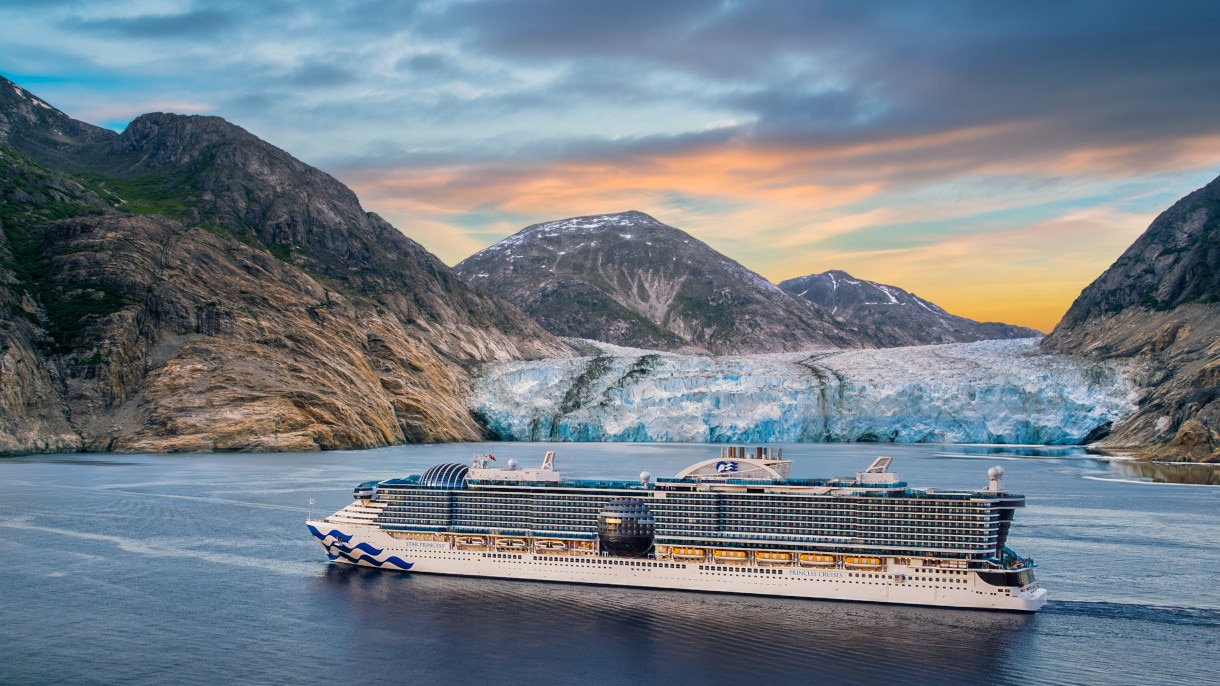
Narrow, glacier-carved and lined with sheer granite cliffs, Endicott Arm and Dawes Glacier offer another exhilarating fjord landscape. Waterfalls spill down the rock walls while floating icebergs drift across the 30-mile passage leading toward Dawes Glacier at the fjord’s head.
The glacier regularly produces powerful calving events, sending chunks of ice crashing into the water below as harbor seals rest on nearby ice floes. For guests wanting a closer perspective on the surrounding wilderness, Endicott Arm and Dawes Glacier Scenic Cruising brings travelers deeper into the fjord aboard smaller excursion vessels designed for perfect glacier viewing.
4. Take in the tidewater glaciers of College Fjord
Named during an 1899 expedition after prominent East Coast colleges, College Fjord cruises showcase one of Alaska’s densest concentrations of glaciers within a single landscape. The fjord contains five tidewater glaciers along with dozens of smaller alpine and valley glaciers descending from the surrounding mountains.
As ships move through the narrow waterway, the scale of glaciation becomes impossible to ignore. Walls of blue ice stretch down toward the water while snow-covered peaks rise above the fjord in nearly every direction, revealing the immense geological force that shaped coastal Alaska over thousands of years.
5. Travel the wildlife-rich Inside Passage
The Voyage of the Glaciers cruise in Alaska travels through the Inside Passage, a protected coastal route winding past forested islands and glacier-carved fjords along Alaska’s southeastern coastline. Because the waters are relatively calm and sheltered, wildlife sightings are common throughout the journey.
Guests often spot humpback whales surfacing beside the ship, bald eagles circling overhead and orcas moving through the passage in search of salmon. Brown bears, harbor seals and sea otters also inhabit the surrounding coastline, making the Inside Passage one of Alaska’s richest ecosystems as well as one of its most scenic sailing routes.

Start your adventure with Princess
Norway's UNESCO-listed fjords

6. Experience the steep cliffs of the Norwegian fjords
Carved by ancient glaciers and later filled with seawater, Norway and Norwegian Fjords cruises travel through some of Europe’s particularly vivid natural landscapes. Along routes through Geirangerfjord and Nærøyfjord, steep mountain walls rise directly from the water while waterfalls spill past tiny villages tucked deep within the valleys below.
Recognized as UNESCO World Heritage Sites for their outstanding natural value, these fjords reveal the immense geological force of glaciation on a remarkable scale. Scenic drives and sightseeing experiences departing from places like Nordfjordeid, Norway, bring guests even closer to the waterfalls, mountain overlooks and glacier-shaped terrain that define western Norway.
Australia's Great Barrier Reef

7. Discover the Great Barrier Reef from Cairns
Stretching more than 1,400 miles along Australia’s northeastern coast, the Great Barrier Reef is the largest coral reef system on Earth and one of the planet’s most complex marine ecosystems. Thousands of coral reefs, small islands and shallow lagoons support endangered sea turtles, dugongs and more than 1,500 species of fish beneath remarkably clear water.
Guests sailing on cruises to Cairns, Australia, can experience this UNESCO World Heritage Site through opportunities like The Great Barrier Reef excursion, which brings travelers directly into one of the world’s most biodiverse marine environments.
New Zealand's Milford Sound and Fiordland

8. Glide through Milford Sound and Fiordland National Park
Remote, rain-soaked and shaped by ancient glaciers, Fiordland National Park protects some of New Zealand’s natural scenery. Sheer cliffs plunge directly into deep water while waterfalls like Stirling Falls and Bowen Falls cascade down the mountainsides after heavy rain.
Princess ships sail directly through Fiordland National Park cruises, which means that guests can experience the scale of Milford Sound from the water itself. Fur seals, dolphins and rare Fiordland crested penguins are often spotted along the coastline, while Fiordland National Park Scenic Cruising offers extended viewing of this UNESCO-listed wilderness.
Iceland's glaciers and lava fields

9. Encounter Iceland's glaciers and geothermal landscapes
Few places reveal Earth’s geological activity as visibly as Iceland. In Iceland cruises, you can see vast glaciers, black-sand coastlines, lava fields and geothermal valleys that sit side by side across a landscape still shaped by active volcanism and shifting tectonic plates.
Guests sailing on Iceland cruises can explore these environments through ports like Reykjavík, Iceland, the gateway to glaciers, geothermal lagoons and the Reykjanes lava fields. Many Reykjavík excursions also visit areas influenced by Vatnajökull, Europe’s largest ice cap, where floating icebergs drift through the Jökulsárlón glacier lagoon toward the sea.
Hawaii's Nā Pali Coast

10. Sail past Hawaii's Nā Pali Coast on Kauai
Towering emerald cliffs rising nearly 4,000 feet above the Pacific make the Nā Pali Coast one of Hawaii’s stunningly recognizable natural landmarks. Over millions of years, volcanic activity and erosion carved the rugged coastline into valleys, hidden beaches and cascading waterfalls that remain inaccessible by road.
Guests sailing on Hawaii cruises can experience the scenery of Kauai during visits to Kauai (Nawiliwili), Hawaii, where many Kauai excursions explore the island’s volcanic landscapes, waterfalls and coastal viewpoints tied closely to Native Hawaiian history and tradition.
Iconic natural landmarks beyond cruise routes
Some of the world’s famous natural landmarks lie far inland or within highly protected environments beyond the reach of traditional cruise itineraries. Even so, they remain essential examples of the geological forces and cultural histories that shape Earth’s most remarkable landscapes.

Uluru, Australia
Rising 1,142 feet above the desert, Uluru is a massive sandstone monolith sacred to the Anangu people and recognized as a UNESCO World Heritage Site for both natural and cultural significance. Its surface shifts through deep shades of red, orange and purple as the light changes throughout the day. Guests interested in combining inland Australia with coastal sailing can explore options through Australia cruises.
The Grand Canyon, United States
Carved by the Colorado River over millions of years, the Grand Canyon exposes nearly two billion years of geological history across its immense rock layers. The UNESCO-listed National Park remains one of the most recognizable natural landmarks in the world and is best experienced through an independent land journey.
The Galápagos Islands, Ecuador
Located roughly 600 miles off the coast of Ecuador, the Galápagos Islands are home to species found nowhere else on Earth, including giant tortoises, marine iguanas and blue-footed boobies. Strict visitor limits help protect the fragile volcanic archipelago that famously influenced Charles Darwin’s theory of evolution in 1835.
Protecting natural landmarks for future generations
The landscapes that make these natural landmarks so unforgettable are also increasingly fragile. Rising ocean temperatures threaten coral reef systems, and retreating glaciers continue reshaping polar environments. Growing tourism places additional pressure on sensitive ecosystems that evolved over thousands of years.
Many regions now rely on strict conservation measures to help preserve these environments. UNESCO World Heritage designations, National Parks and protected marine reserves establish guidelines that limit further development and support long-term scientific research. This helps safeguard wildlife habitats and preserve the natural beauty of these magical sites.
Travelers also influence the future of these places through the choices they make ashore. Staying on designated paths, respecting wildlife viewing distances and supporting responsible tourism operators all help reduce environmental impact in vulnerable regions.
Across destinations like Alaska, Princess® partners with local experts, naturalists and Park Service rangers who provide educational context that deepens guests’ understanding of the ecosystems and cultural heritage surrounding these remarkable natural landmarks.
Planning your cruise to natural landmarks
Alaska glacier cruises provide direct access to glacier-based natural landmarks anywhere in the world, with multiple landmark regions often experienced during a single voyage. Voyage of the Glaciers cruises combine destinations like Hubbard Glacier, Glacier Bay and College Fjord into one immersive sailing through Alaska’s glacier-filled wilderness.
Beyond Alaska, Princess itineraries continue into other landmark-rich regions, including Norway and Norwegian Fjords cruises, Australia and New Zealand sailings. These feature landmarks such as the Great Barrier Reef and Fiordland National Park. And of course, don’t forget about Iceland and Hawaii voyages shaped by volcanic and coastal geology.
Throughout the journey, onboard naturalists and Park Service rangers often provide insight into the wildlife, geology and Indigenous heritage connected to these environments. Booking shore excursions in advance can also help secure access to popular glacier cruises, reef experiences and scenic touring opportunities during peak travel seasons.
Explore natural landmarks on Alaska cruises
What makes Alaska so memorable is the sense of constant change. With these lively landmarks, no two days along the coastline ever feel exactly alike. Traveling by ship allows guests to remain closely connected to these landscapes for hours at a time rather than experiencing them only from distant viewing areas ashore — you don’t have to miss a thing.
Through Alaska cruises, Princess® guests can spend meaningful time among glacier-filled fjords and protected wilderness regions while learning more about the land connected to Alaska’s natural landmarks. Book yours today to experience the awe-inspiring feeling of Alaska for yourself.
Natural landmarks FAQs


