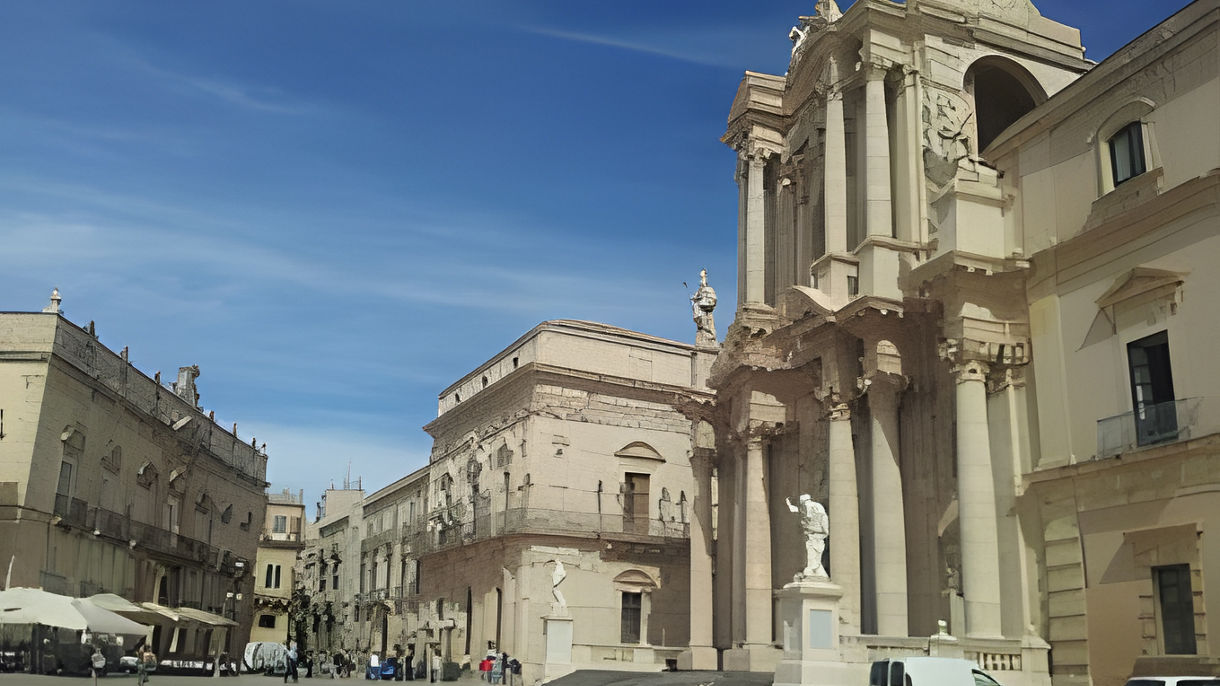
Ortygia at Siracusa
Strenuous Activity
Includes meal
Be sure to read the Special Notes further down this page for important requirements and restriction.
Standing at the crossroads of Europe and northern Africa the city of Siracusa was considered the most powerful piece of real estate in Sicily and once rivaled Athens as the most important city of the Greek world.
Original founded as a Greek colony in 734 B.C., the city would eventually fall to the Romans, Byzantines, Vandals, Arabs, Normans and Spanish. Each of these conquerors left behind an architectural legacy that's considered grand in every sense of the word and acclaimed by UNESCO as a World Heritage Site.
Spend the day exploring the original Greek settlement called Ortygia and behold some of the splendid wonders of the ancient world where Cicero, Archimedes, emperors and Greek gods once walked.
Your odyssey begins as you board your coach for the approximate one-hour drive to the southern coastal city of Siracusa. Once you arrive you'll cross three bridges over the narrow channel that connects the town to the island of Ortygia.
Once you're in the Old Town you'll disembark near the Arethusa Fountain, a freshwater spring that's rooted in ancient Greek mythology. According to legend, the goddess Artemis changed a nymph named Arethusa into water to escape the river god Alpheus and the transformed maiden emerged in this spot.
Feel the centuries slip away as you amble along the narrow streets to a popular viewpoint that boasts beautiful views of the bay. Photos taken, you'll proceed to the pedestrian-friendly Piazza Duomo. Here stands some of the city's most impressive Baroque architecture from the 17th and 18th centuries.
Dominating the piazza is the resplendent Siracusa Cathedral. As the center of Greek, Byzantine and Judaic civilizations, the cathedral has been transformed through the centuries as a reflection of each religion's faith. Built in the 7th century on the former Temple of Minerva, the cathedral was sacked by Arabs in 878 and converted into a mosque. Norman invaders modified the church 200 years later and reconstructed yet again after the destructive earthquake of 1693.
Next, you'll drive to the Neapolis Archeological Park, which holds Siracusa's greatest concentration of ruins. Follow the path to the Greek Theater and marvel at its size-measuring 1,492 in diameter, it's one of the largest in the world. Built in the 5th century B.C., the well-preserved amphitheatre was carved out of the rock.
Further on you'll see the last remaining columns and long stone base of the 3rd century B.C. altar of Hieron II, the Greek king who ruled Syracusa from 270 to 215 B.C.; at 653 by 75 feet, it's the longest altar ever built.
Not to be outdone, the Roman's built their own theater. Another pathway leads to the 1st century A.D. Roman amphitheater, where Siracusans held bloody gladiator fights.
At the end of this memorable excursion you'll rejoin your coach and head to a local restaurant for lunch. Later, you'll journey back to Catania, your heart and camera filled with wonderful memories of breathtaking beauty.
Points of interest
Siracusa (Syracuse)
Schedule
Special Notes
Tour order may vary. Use of an audio headset (included) will enhance your tour experience.
Exceptional Value
Book shore excursions with confidence! We offer competitive pricing, friendly service and unmatched destination expertise.
Strenuous Activity
Includes meal
Be sure to read the Special Notes further down this page for important requirements and restriction.
Standing at the crossroads of Europe and northern Africa the city of Siracusa was considered the most powerful piece of real estate in Sicily and once rivaled Athens as the most important city of the Greek world.
Original founded as a Greek colony in 734 B.C., the city would eventually fall to the Romans, Byzantines, Vandals, Arabs, Normans and Spanish. Each of these conquerors left behind an architectural legacy that's considered grand in every sense of the word and acclaimed by UNESCO as a World Heritage Site.
Spend the day exploring the original Greek settlement called Ortygia and behold some of the splendid wonders of the ancient world where Cicero, Archimedes, emperors and Greek gods once walked.
Your odyssey begins as you board your coach for the approximate one-hour drive to the southern coastal city of Siracusa. Once you arrive you'll cross three bridges over the narrow channel that connects the town to the island of Ortygia.
Once you're in the Old Town you'll disembark near the Arethusa Fountain, a freshwater spring that's rooted in ancient Greek mythology. According to legend, the goddess Artemis changed a nymph named Arethusa into water to escape the river god Alpheus and the transformed maiden emerged in this spot.
Feel the centuries slip away as you amble along the narrow streets to a popular viewpoint that boasts beautiful views of the bay. Photos taken, you'll proceed to the pedestrian-friendly Piazza Duomo. Here stands some of the city's most impressive Baroque architecture from the 17th and 18th centuries.
Dominating the piazza is the resplendent Siracusa Cathedral. As the center of Greek, Byzantine and Judaic civilizations, the cathedral has been transformed through the centuries as a reflection of each religion's faith. Built in the 7th century on the former Temple of Minerva, the cathedral was sacked by Arabs in 878 and converted into a mosque. Norman invaders modified the church 200 years later and reconstructed yet again after the destructive earthquake of 1693.
Next, you'll drive to the Neapolis Archeological Park, which holds Siracusa's greatest concentration of ruins. Follow the path to the Greek Theater and marvel at its size-measuring 1,492 in diameter, it's one of the largest in the world. Built in the 5th century B.C., the well-preserved amphitheatre was carved out of the rock.
Further on you'll see the last remaining columns and long stone base of the 3rd century B.C. altar of Hieron II, the Greek king who ruled Syracusa from 270 to 215 B.C.; at 653 by 75 feet, it's the longest altar ever built.
Not to be outdone, the Roman's built their own theater. Another pathway leads to the 1st century A.D. Roman amphitheater, where Siracusans held bloody gladiator fights.
At the end of this memorable excursion you'll rejoin your coach and head to a local restaurant for lunch. Later, you'll journey back to Catania, your heart and camera filled with wonderful memories of breathtaking beauty.
Points of interest
Siracusa (Syracuse)
Schedule
Special Notes
Tour order may vary. Use of an audio headset (included) will enhance your tour experience.